Sound & newborn care
White noise for babies: an app or a separate sound machine?
Calma editorial team · Sources checked 8 November 2026
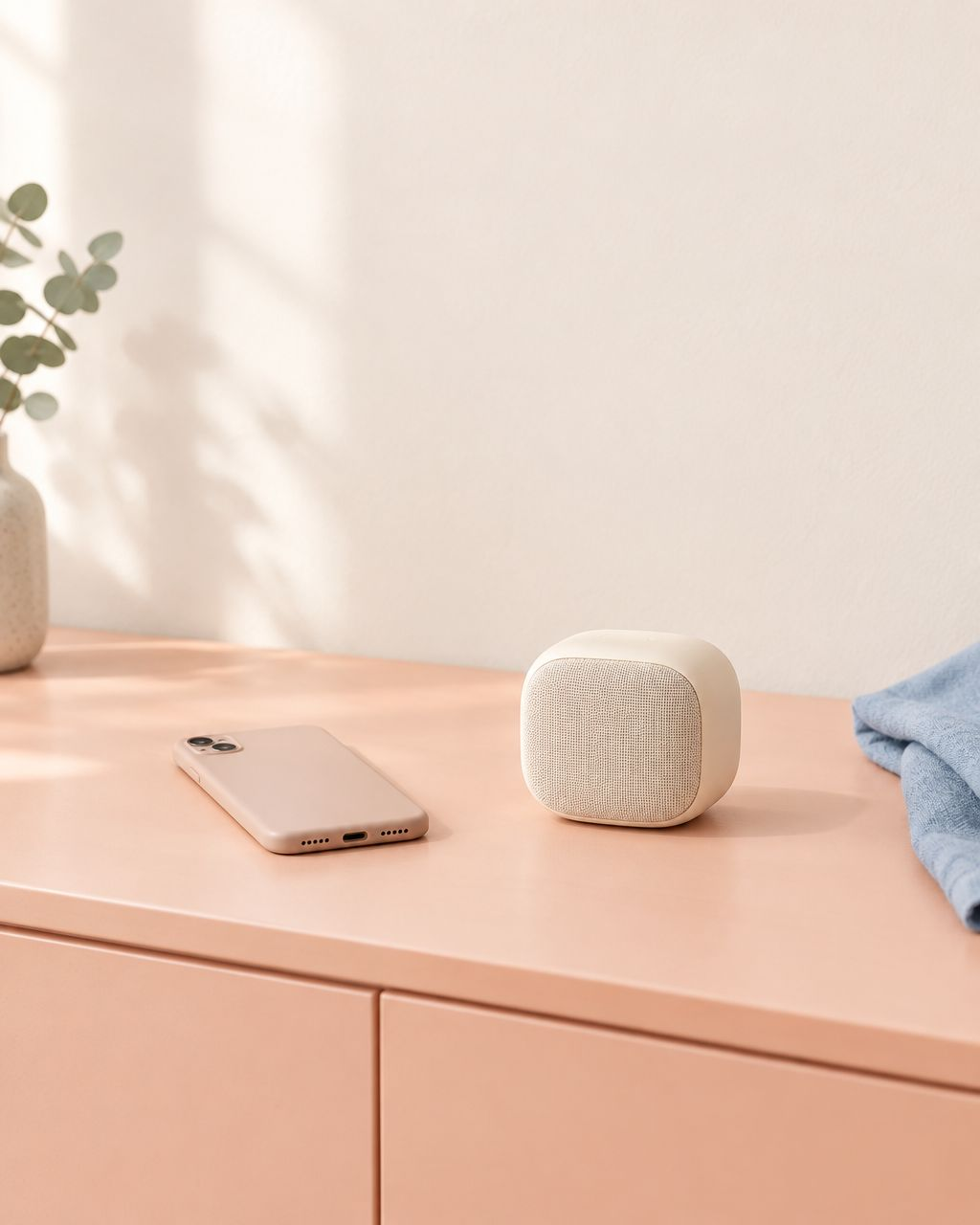
Choose an app for white noise for babies if you can leave a suitable phone in place during playback; choose a separate sound machine if you need your phone elsewhere. Neither format guarantees better sleep or safe sound levels, so compare the controls and placement—not just the sound library.
Key takeaways
- An app uses a phone you already have; a separate sound machine keeps playback off that phone.
- Neither option is automatically safer: volume, distance and listening time matter.
- Check timers, power needs and playback interruptions before choosing white noise for babies.
- Quiet is an option too; a sound device is not a newborn essential.
The practical difference is whether the sound shares a device with your other daily tasks. An app can mean less equipment to pack, but the phone playing it must stay where you placed it. A separate machine adds equipment while leaving your everyday phone available.
For an introduction to the sound itself, see our guide to choosing white noise for newborns. This comparison is about choosing a playback setup, not proving that one device helps babies sleep longer.
| Option | Best for | Practical benefit | Main limitation |
|---|---|---|---|
| White noise app | Parents who can leave a suitable phone in place | Uses a device you already carry | Shares that device with calls, alarms and other tasks |
| Separate sound machine | Parents who need their phone elsewhere | Separates sound playback from everyday phone use | Adds another device, with model-specific power and controls |
| No added sound | Families comfortable with the room as it is | No setup, charging or added sound exposure | Doesn't add a background sound if you want one |
These are category tradeoffs, not results from a product test. Apps differ, and so do machines. Check the particular product rather than assuming every device in a category behaves alike.
Why this choice matters when you're tired
A long feature list doesn't tell you whether a setup will be easy to use during an ordinary evening. Think about who needs the phone, where the sound source can sit and how you will stop playback. Those details are more useful than choosing the device with the most sounds.
You can also decide not to add audio. A sound machine isn't a required nursery purchase, and an app isn't something you must download before your baby arrives. If the room already feels quiet enough, there may be nothing to solve.
Choose an app when leaving a phone in place is practical
An app makes sense when you have a compatible phone available for the listening session. You can choose audio and controls on a device you already understand rather than learning another set of buttons.
The limitation is straightforward: if you take the playback phone into another room, you have changed the setup. Don't solve that inconvenience by putting it closer to your baby so you can reach it more easily. Choose a stable location away from the sleep space first, then decide whether the phone can stay there.
Before choosing an app, check:
- Whether your phone supports the app.
- Whether the sound works without an internet connection.
- How playback behaves when a call or necessary alarm arrives.
- Whether a timer and gradual ending are available.
- How you will keep charging cables out of reach.
A spare phone can separate playback from your everyday calls, but it still needs checking. Confirm that the app works on it, that the device is in good condition and that you can operate it without frustration. An old phone is not automatically a useful spare simply because it turns on.
Choose a separate machine when you need your phone elsewhere
A dedicated sound machine suits a household where the everyday phone needs to move between rooms or caregivers. The point is separation: the playback device can remain in its chosen location while your phone comes with you.
That convenience comes with another item to place, power and pack. Machines differ in whether they need batteries, a socket, an app or an internet connection for particular functions. Check the instructions for the exact model instead of assuming a physical machine works independently in every situation.
Look for clear answers to these questions:
- Can you start, lower and stop the sound on the device itself?
- Does the model have a timer, and what happens when it ends?
- What powers it, and where will the cable sit?
- Which functions need another device or a connection?
- Can you keep any lights dim or off, if that matters to you?
A machine with more controls isn't necessarily easier. If another caregiver will use it, make sure they can lower and stop the sound without having to search for instructions. That is a more useful household test than the number of tracks on the box.
Neither format wins on safety by default
The American Academy of Pediatrics' guidance on noise exposure, written by pediatrician Sophie J. Balk, warns that some infant sleep machines produce hazardous noise levels. It advises placing a sleep machine as far from the baby's head as possible and using it for a short time only.
A product marketed for babies still needs careful use. A phone's percentage setting, a machine's numbered dial or a gentle-sounding recording does not by itself tell you the sound level at your baby's ears.
Choose a setup that makes low, limited playback easy—not one that encourages you to cover every noise. If you keep raising the level to compete with a television, lower or turn off the television first where practical.
For either format:
- Keep the device outside the crib or bassinet.
- Use a stable surface and keep cords out of reach.
- Keep playback low and limit listening time.
- Follow the product's instructions without treating marketing language as safety certification.
- Ask your baby's clinician about hearing concerns or individual medical needs.
Changing the color of the noise doesn't remove these questions. A deeper sound can feel different to an adult listener without establishing a safer level. Volume, distance and duration still deserve attention.
What changes the decision from one household to another?
Who needs the playback phone?
If your phone is also how you receive important calls, work messages or caregiving alerts, think through that conflict before choosing an app. Don't turn off an alert you rely on just to keep a recording uninterrupted.
A separate machine or a suitable spare phone can keep those jobs apart. The better arrangement is the one that preserves the communications your household needs, not the one that demands the fewest notifications.
Where can you place the device?
Start with the room, not the shopping list. A device that only works conveniently on the crib rail or beside your baby's head is not the right setup. Keep the source away from the sleep space and check cable routing before playback.
Moving to a different bedroom means checking again. Don't assume a previous volume setting or placement works unchanged in a different room.
How does it stop?
Check the ending as carefully as the opening. Does a timer stop playback, fade it down or leave another track running? Test the actual setting you intend to use rather than relying on a product description alone.
An all-night option describes a feature, not a recommendation that your baby needs continuous exposure. The ability to keep playing shouldn't choose the duration for you.
What happens without a connection?
Some audio is stored on the device; other playback depends on a connection. Check your specific app or machine before travel, especially if you expect it to work somewhere unfamiliar.
Offline playback addresses the connection question. It doesn't establish that every call, alarm or device setting will behave the way you expect. Those are separate checks.
What else will you need to carry?
An app avoids packing a separate playback unit, but the phone still needs power. A machine adds its own power arrangements and any accessories required by that model.
Choose based on your actual bag and routine. Neither the smallest device nor the longest feature list is useful if the setup creates more work than you want.
What does a white noise app offer in practice?
The Calma white noise app for iPhone offers timers, gentle fades, offline playback and optional mixing with lullabies, according to its product page checked November 8, 2026. Calma suits iPhone parents who want sound and lullaby controls together without carrying a separate playback unit.
Its limitation is the same practical one discussed above: the playback phone needs to remain appropriately placed. Calma is for iPhone, and its controls do not guarantee better sleep or a safe sound level at your baby's ears.
The product instructions say to keep the phone at least 2 meters from the cot and describe sound levels as estimates. Treat that distance as a product instruction, not a universal guarantee. Keep the source as far from the baby's head as possible, use a low setting and limit exposure.
You do not need to use every available feature. If a simple background sound is what you want, adding a lullaby is optional. Choose controls that reduce effort rather than building a complicated mix because the app allows it.
Does a separate machine make the sleep space safer?
No. Buying a dedicated machine does not make an unsafe sleep surface appropriate, and white noise is not a SIDS-prevention measure. Sound playback is separate from the choices that make an infant sleep space safer.
Follow the AAP's safer-sleep recommendations: place your baby on their back on a firm, flat, noninclined infant sleep surface without loose bedding or soft objects. The AAP recommends room sharing without bed sharing for at least 6 months, preferably up to 1 year.
Do not put a phone, machine or loose accessory in the crib to make the sound more convenient. If your room doesn't allow appropriate placement, choose quiet instead of forcing the setup.
Should you buy another device if your current setup works?
Not just to collect more features. If you already have a suitable setup that you can use quietly, at a distance and for limited periods, another device is not automatically an improvement.
Name the actual problem first: needing your phone elsewhere, confusing controls, unwanted track changes or inconvenient power arrangements. Then choose an option that addresses that problem. If you cannot name one, you can leave the purchase for another day.
FAQ
Is an app or a sound machine better for white noise for babies?
An app suits parents who can leave a compatible phone in place; a separate machine suits parents who need that phone elsewhere. Neither format guarantees better sleep or safe sound levels.
Can I use my phone for baby white noise?
A compatible phone can play white noise, but keep it outside the crib, away from your baby's head and with cords out of reach. Check the app's instructions, use a low setting and limit listening time.
Is a dedicated sound machine automatically safer than a phone?
No. Output level, distance and exposure time matter for either setup. A device marketed for babies is not automatically safe at every setting.
Do all white noise apps work offline?
No category-wide promise applies. Check the particular app; Calma's current product page says its iPhone sounds work offline.
Should white noise play all night for a baby?
Do not assume continuous playback is necessary. AAP guidance advises short use of infant sleep machines; an all-night feature is not an individual listening recommendation.
Can I put a white noise machine inside the crib?
Keep the device outside the crib and as far from your baby's head as possible. Keep power cords and accessories out of reach too.
Does my baby need white noise at all?
No. White noise is optional, and quiet is a valid choice. Sound does not replace responsive care, feeding or a safer sleep space.
One last thing
The best reason to change devices is a practical problem you can name. Needing your phone in another room is a clear reason to consider a separate machine. Wanting simpler playback on a phone you can leave in place is a clear reason to consider an app.
Neither choice needs to become a project. Choose the arrangement you can manage gently, and remember that no added sound is an option too.
Written by the Calma editorial team. Safety guidance draws on the American Academy of Pediatrics, including noise guidance by Sophie J. Balk, MD, FAAP. This article has not been individually reviewed by a clinician and is not individual medical advice. Sources and product information checked November 8, 2026.